Rule 17 of George Washington's Rules of Civility is eleven words long: "Be no Flatterer, neither Play with any that delights not to be Play'd Withal" (Mount Vernon).
Ah, the art of flattery. That delicate dance where insincerity masquerades as admiration. I'm always reminded of Al Czervik in Caddyshack; “Oh, this your wife, huh? A lovely lady. Hey baby, you must've been something before electricity” . His flattery was so obviously sarcastic that no one could miss it. Washington's warning is about the other kind, the kind that comes across as sincere.
Two of the Founders spent their careers on that warning, and both have anniversaries this week.
Hamilton's warning, 239 years ago this week
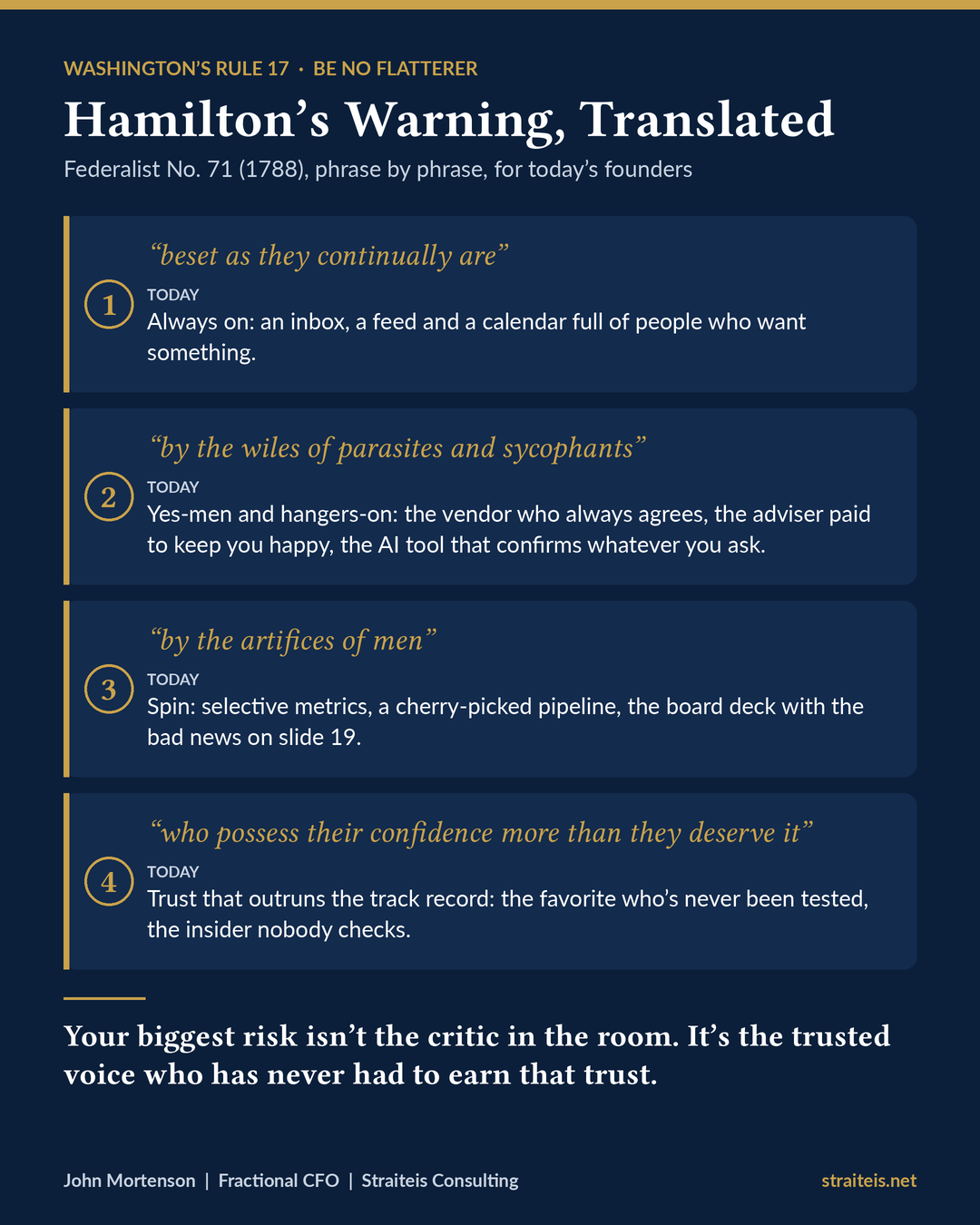
On October 27, 1787, the first Federalist essay appeared in New York's Independent Journal (Founders Online). In it, Alexander Hamilton warned that history's most dangerous men "have begun their career by paying an obsequious court to the people; commencing demagogues and ending tyrants." Yikes! That’s a mouthful. He came back to the theme in Federalist No. 71. The people, he wrote, mean well but sometimes err, and the wonder is how seldom they do, "beset as they continually are by the wiles of parasites and sycophants... by the artifices of men, who possess their confidence more than they deserve it" (University of Chicago, The Founders' Constitution). That’s not just a mouthful…it’s a smackdown
Read that last phrase again: people who possess their confidence more than they deserve it. Every leader has met one.
Adams's answer: facts are stubborn things
John Adams, born October 30, 1735 (White House Historical Association), gave the best answer to flattery in American history. And he gave it when it cost him something.
In 1770, Adams agreed to defend the British soldiers charged in the Boston Massacre, the most despised defendants in the colonies. In his closing argument he told the jury: "Facts are stubborn things; and whatever may be our wishes, our inclinations, or the dictates of our passions, they cannot alter the state of facts and evidence" (National Park Service). Adams later called the defense "one of the best Pieces of service I ever rendered my Country" (Library of Congress).
That sentence belongs on the wall of every finance department.
The flatterer in your company
In a growing company, flattery rarely sounds like praise. It sounds like agreement:
• The forecast that always lands exactly where the CEO hoped.
• The pipeline report that counts every "great meeting" as a probable deal.
• The board deck that leads with wins and puts the cash runway on slide 19.
• The adviser who never says no, because no is bad for the relationship.
There's a newer flatterer too. A study published in Science by Stanford researchers found that leading AI chatbots affirmed users' actions 49% more often than humans did, and that participants rated the flattering answers just as objective as honest ones (Fortune). If your team is now using AI to build forecasts or review plans, the yes-man may be in your software.
Even the professionals slip. This month the UK's Financial Reporting Council fined Deloitte UK $7.9 million over audits of Go-Ahead Group, where the firm failed to apply sufficient professional skepticism (CFO Dive). Skepticism is simply the professional word for refusing to flatter the numbers.
Four habits that keep flattery out of the numbers
1. Hire a finance lead whose job is to disagree. Reward the person who brings bad news early. Then watch how you react when they do, because your team is watching too.
2. Ask for the downside case first. Before you see the plan, ask what has to be true for it to fail. A forecast built only to please is not a forecast.
3. Make your AI tools argue with you. Ask them to find the weakest assumption in the model, not to confirm it.
4. Put the hard number on page one. Cash runway, covenant cushion and customer concentration belong at the front of the board deck, not the back.
Washington's rule has a second half that's easy to skip: don't keep company with those who delight in being flattered. For a founder, that's a mirror. If the people around you always agree, ask whether you've made it unsafe to do anything else.
Flattery is often mistaken for true admiration, and sincerity is a rare and precious commodity. In finance, it's also the cheapest insurance you'll ever buy.