The Off-Site Is Not the Plan
It's October, which means a lot of leadership teams are about to spend two days in a hotel conference room with a facilitator, a stack of sticky notes and a whiteboard full of ideas. There will be a SWOT analysis, a refreshed vision statement, a list of strategic priorities and, most likely, a very expensive dinner that spills out into the hotel bar. Everyone will leave energized. The CFO will wish someone had budgeted for the $25,000-plus tab.
By February, the binder will be on a shelf, and the company will be running exactly the way it ran before.
This isn't a cynical take. It's what the research says. In a McKinsey survey of nearly 800 executives, only 45% were satisfied with their strategic planning process, and only 23% said major strategic decisions were actually made within it (McKinsey). Kearney's newest study, published in August, finds that only 29% of transformations consistently deliver the value they set out to deliver, with resistance to change cited ahead of budget, timelines and technology (Kearney via PR Newswire).
The off-site isn't the problem. Treating the off-site as the plan is.
Why Off-Sites Fail in Founder-Led Companies
I've sat in the CFO, COO and CEO seats, and each one sees a different version of the same failure. The CEO leaves with a vision. The COO leaves wondering who's going to do the work. The CFO leaves wondering how any of it gets paid for. When those three views never get reconciled in the room, the plan is dead on arrival.
Bain describes four pitfalls of strategic planning that map almost perfectly onto what I see in $5M–$50M companies (Bain & Company):
Opinions instead of facts. Time goes to the wrong issues, discussion runs on opinion rather than data, and there's little real debate about alternatives. In a founder-led company, the founder's opinion usually carries the room.
Settling for underperformance. Teams avoid naming the company's full potential because it might become their target, and the numbers get sandbagged when strategy turns into a budget.
A road to nowhere. Discussions don't produce decisions. They produce themes, like "grow the enterprise segment" or "become more customer-centric," that no one owns or is accountable for.
Looking backward. Reviews focus on last year's results instead of the leading indicators that will drive next year's.
I'd add a fifth that is specific to smaller companies: the plan never meets the money. The off-site approves six priorities. Then the budget, usually a projected P&L with revenue up X percent and expenses up at the rate of inflation, funds the same things it funded last year, and nobody notices until the third quarter. A strategy that isn't reflected in the budget is just a wish list.
Decisions, Not Themes
The single change that fixes most off-sites is to organize the session around decisions instead of discussion.
Bain made this argument years ago: strategic planning most often acts as a barrier to good decision making, and the fix is to identify the decisions that create value first, then use the planning process to build the roadmap for carrying them out (Bain & Company). Top-quintile decision makers generated total shareholder returns nearly 6 percentage points higher than everyone else (Bain Decision Insights).
A theme sounds like "expand into the Southeast." A decision sounds like "we will open a Charlotte office by May 1 with three hires and a $600,000 budget. Maria owns it, and we'll know it's working if we have $1.5 million in qualified pipeline by September." One of those can be executed. The other can only be discussed again next October.
How to Run It - Four to six weeks before
Write the decision list. Pick the five to seven decisions the team must make. Not topics, decisions. For example: Do we enter this market? Do we raise prices? Do we keep this product line? Do we hire a VP of Sales or promote from within?
Build the fact base. For each decision, assemble a short pre-read with the data, the options and the trade-offs. Bain's guidance is to get agreement on the facts before anyone proposes solutions (Bain & Company). The data should already be in your KPIs. If it doesn't exist yet, delegate the data collection and presentation to department managers so they own it. Don't make the mistake of showing up with an armful of data no one has seen before.
Interview the team one-on-one. The facilitator should sit down with eacg department head before the meeting. Managers will say things privately that they won't say in front of the founder. The facilitator should bring those themes into the room without attribution.
Bring in the capital constraint. The CFO should arrive with the preliminary 2027 cash and funding picture: how much capacity the company actually has to invest, and at what cost. The CFO should also set the hurdle rates, meaning the minimum IRR and payback period any capital project must clear. Every priority on the table competes for the same dollars.
In the room
Keep it small. Every department should be represented, but smaller is better: six to ten leaders, the people each department reports to, who actually own outcomes. The last session I facilitated had thirty people in the room, ten of them dominated the discussion, and the bill came to roughly $50,000. Every additional person makes debate less candid and adds cost.
Use a facilitator who isn't the founder. The founder participates but doesn't run the meeting, and speaks last on each decision. That isn't about having the last word. When the founder goes first, managers fall in line and nod. Strong founders want to hear their managers first.
Day one is facts and options. Review the fact base, pressure-test assumptions and lay out real alternatives for each decision.
Day two is decisions. Close every item on the list, even if the decision is to gather one specific piece of information and decide by a fixed date.
Name what you'll stop doing. Every new priority needs funding and people. If the team can't say what it's giving up, it hasn't really decided anything.
The decision log
The off-site should end with a single document. Not a 30-page deck, but a decision log everyone in the room signs off on before they leave:
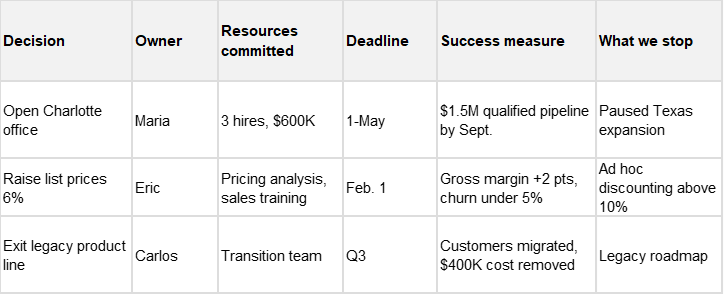
If a priority can't fill every column, it isn't ready to be a priority.
The 90 days after
This is where most plans die and where most of the value is created.
Week one: Translate every decision into the 2027 budget and capital plan. If a decision isn't funded, it didn't happen.
Week two: Each owner presents a one-page execution plan with milestones and leading indicators.
Monthly: A 60-minute strategy review, separate from the operating review. Discuss the leading indicators, not last month's P&L.
Quarterly: Revisit the decision log. Keep, change or kill each item based on what you've learned.
Bain's current view is that rigid calendar-year planning cycles are obsolete. Its approach pairs a delivery agenda for what's predictable with a development agenda for what's uncertain and allocates resources dynamically through the year (Bain & Company). For a mid-market company, that doesn't require an elaborate new planning apparatus. It requires a monthly meeting and a decision log that actually gets updated.
Kearney's research makes one more point worth noting: companies that build capability from day one are nearly three times more likely to realize the value they expected (Kearney via PR Newswire). In practical terms, that means the people who will carry out the decisions need to be trained, staffed and equipped before you hold them accountable.
Choosing a System to Carry the Plan
A decision log tells you what you decided. You still need a system that carries those decisions through the year. Most recently I've used OKRs, but I've used several other execution systems over my career. My conclusion is that the system matters far less than the discipline of running it.
In the 1990s, I ran planning off C. Davis Fogg's "Implementing Your Strategic Plan." Part of why I picked up the book is that I'm a Jules Verne fan. In "Around the World in Eighty Days," Verne's Phileas Fogg (no relation to C Davis) wins his wager by carrying out a plan with relentless precision. He has a fixed deadline, a timetable and constant checks on progress, and he adjusts when things go wrong. C. Davis Fogg built his book around 18 keys to execution, drawn from his own experience and interviews with CEOs who had actually made change stick (Google Books). Most of what he got right still holds. Turn priority issues into assigned responsibilities. Build the plan into every department. Negotiate individual accountabilities. Allocate the resources. Review relentlessly. And remember his central point: leadership is the single most important factor in making change happen (ValueBasedManagement.net).
Every framework that has come along since, OKRs included, is a variation on those fundamentals. OKRs fit the off-site process well. Each decision on the log becomes an objective. Its success measure becomes two or three key results, set by quarter and cascaded to the department level. The monthly strategy review becomes the place where you score the key results and decide what to change.
Other systems can work just as well. Scorecard-based approaches, quarterly-priority systems and weekly meeting cadences are all built on the same idea: a few priorities, clear owners, visible measures and a regular rhythm for reviewing them. Whichever you choose, a few rules apply:
Keep it small. Three to five objectives for the company, not fifteen. If everything is a priority, nothing is a priority, and the system becomes a reporting exercise.
Separate stretch goals from commitments. Key results meant to stretch the team shouldn't be confused with the numbers in the budget. Mixing them invites the sandbagging Bain warns about.
Don't tie it directly to bonuses in year one. Once compensation rides on the score, people start negotiating easier targets.
Connect it to the capital. Every objective should trace back to a line in the budget and capital plan. If it doesn't, it will lose the first fight for resources.
Pick one system and stay with it. Switching frameworks every year teaches the organization that the system is optional.
The off-site makes the decisions. The execution system is how you keep them.
How to Tell Whether It Worked
Ninety days after your off-site, ask five questions:
Can every member of the leadership team name the five to seven decisions without looking them up?
Is each decision reflected in the 2027 budget?
Has at least one thing the company used to do actually stopped?
Has the monthly strategy review happened every month?
Has at least one decision been changed or killed based on new information?
If the answer to most of those is no, you didn't run a strategic planning process. You held a retreat.
The Real Question
Founders don't lack ideas. They usually have too many. The value of a strategic planning process lies in forcing a small number of clear decisions, funding them, assigning them to people who are accountable, and checking every month whether they're working.
The off-site is one day in that process. It's an important day. But the plan is everything that happens afterward.